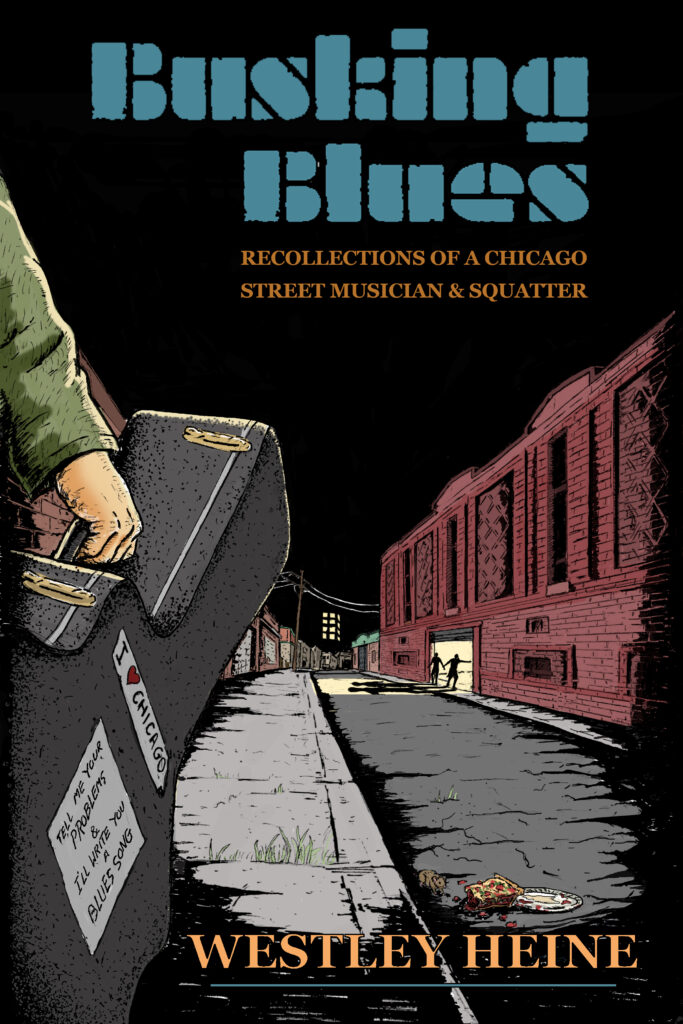
Alan Catlin reviews THE PEOPLE ARE LIKE WOLVES TO ME by William Taylor Jr.

first published in Misfit Magazine, Alan Catlin, ed.

William Taylor Jr., The People Are Like Wolves to Me, Roadside Press, roadsidefam.com distributed by Magical Jeep, also available on Amazon, 2025, 85 pages, $17.

If his poetry is to be taken literally, and there is no reason not to take him at his word, Taylor is a melancholy man. He prefers his own company to that of mass gatherings. Taylor feels a kindship with a few old drunks in a dive bar who are lost in the last days of their drinking themselves to death than he is in other public places where people, or worse, tourists, gather to gawk at the locals in their natural habitat. In a way these poems feel like a Jack Lodonesque, or Orwellian Down and Out descriptive testimony of life in the tenderloin district of San Francisco. Taylor isn’t abjectly poor, as are the people in London and Orwell’s books, but there is a boat load of loneliness and solitude for people failing to make human connections. There is also a sense of the absurd, a kind of quiet wry humor in Taylor’s observations. A recurring image is that of the “famous poet” whose self-assurance and blind allegiance to the wonderfulness of himself, only partially obscures the facile personality of someone whose ego is greater than his accomplishments. We don’t know exactly who this famous poet is but we know exactly what he is, a phony, the worst kind of phony, and he could be anyone.

Another recurring personality is the beautiful blonde bartender who feels vacuous in a way that only a woman who is as beautiful as she is, and knows it, can be. She is still young enough to have a heart and a curious mind, but ultimately, feels as if she is falling victim to her beauty and isn’t motivated to do anything about it. It’s so much easier to go with the flow than become a fully developed person.

An encounter with a woman causes hm to re-evaluate his opinion of Janis Joplin and he finds, despite himself, a certain kinship he previously paid no attention to. It isn’t life changing but it is amusing. Ultimately Taylor is not a depressive nor are his poems depressing. There is a thin red line between depression and loneliness/sadness and Taylor treads it carefully with a keen eye.  There are broken hearts and lost loves, major disappointments along the way, but you don’t have to let your setbacks define or break you. Taylor certainly does not. The most emblematic poem for me in The People Are Like Wolves to Me is “In Search of It.” Having already established that the human condition appears to be all about people perceiving others having what they are looking for the sum up his feelings of life,

The people have failed me,
the government has failed me
I have failed myself.

All of which is commonplace,

but I’ve grown bitter with hope
forever tricking me
into mucking through it all
just to reach the next rotten thing.

Yet here I am in search of it
(from In Search of It)

Taylor has decided to stick around because he loves the sound of the rain, the feeling the warmth of the sun. He calls himself the Walt Whitman of End Times and he might well be.

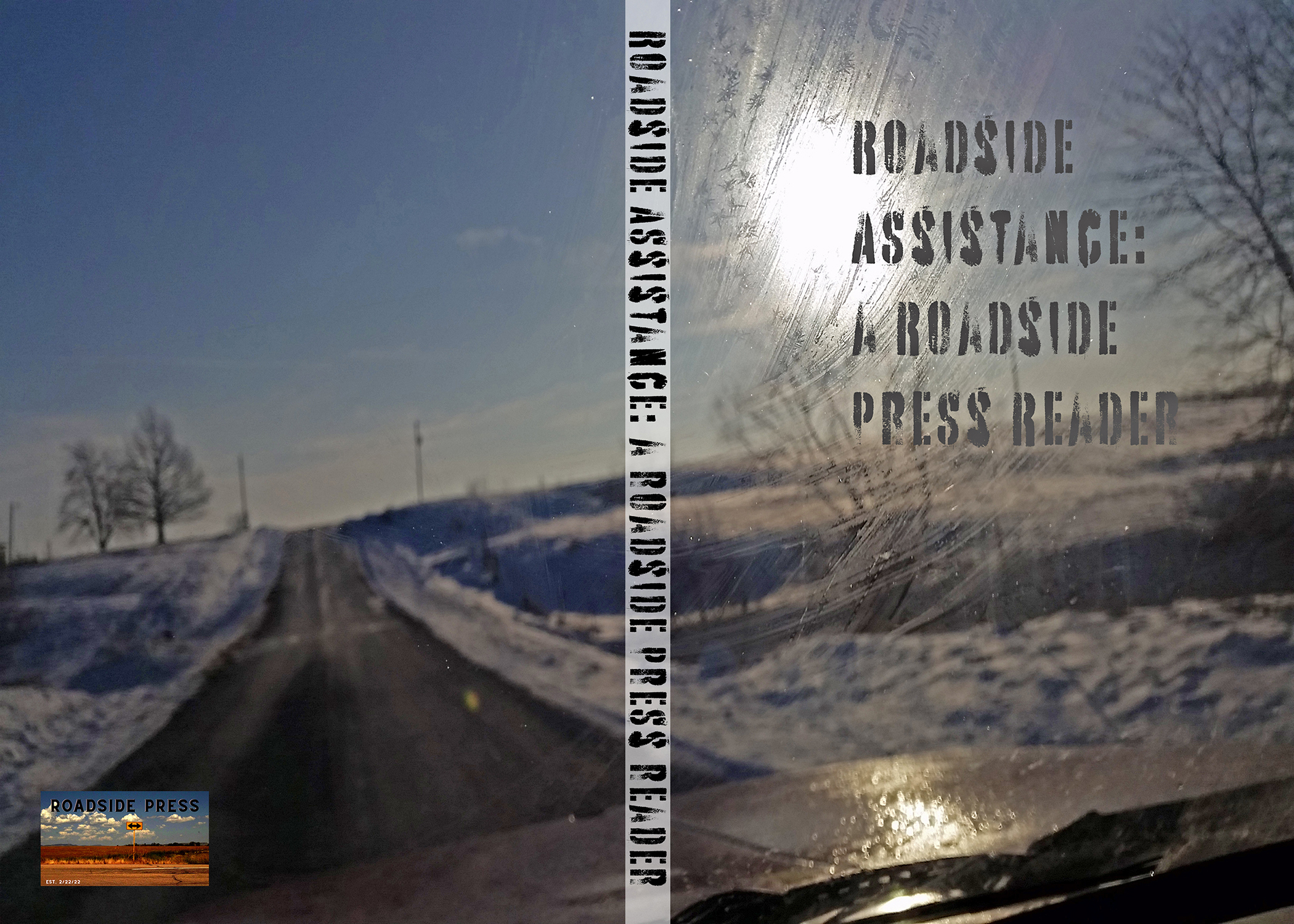
Alan Catlin reviews Roadside Assistance: A Roadside Press Reader

first published in Misfit Magazine, Alan Catlin, editor

Roadside Assistance: A Roadside Press Reader,
roadsidefam.com, available on Amazon, 2026, 198 pages, $20, https://www.magicaljeep.com/product/roadside/SO7LETPOXJR5T4LEQK36FBRE

This weighty collection is not a best of the press’s books so much as a selection of the work of 48 poets and writers of fiction all of whom had a book printed by the press from 2022 to 2026. Rather than run a Go Fund Me for the press, co-editor Dan Denton helped Michele collect writing to produce this volume so that everyone is represented and the press is benefited.  I may be prejudiced, as I have published several books with the press, but I think there is a wealth of kickass work here that should appeal to just about any non-academic reader.

Dave Newman, Lori Jakiela, William Taylor, Scot Young, Dan Denton, Westly Heine, Jennifer Juneau, Belinda Subraman, Dan Provost, Francine Witte, Nathan Graziaono, editor McDannold and Denton plus many more.

Richard Modiano reviews ROADSIDE ASSISTANCE: A ROADSIDE PRESS READER

first published at The Literary Underground’s In Conversation
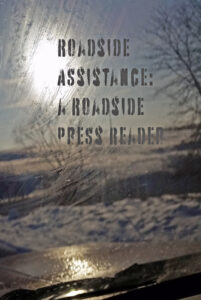
Roadside Assistance: A Roadside Press Reader

edited by Dan Denton & Michele McDannold

There’s something refreshingly unvarnished about Roadside Assistance: A Roadside Press Reader — a book that refuses polish in favor of presence. As the publisher’s note makes clear, this is not a curated “best of,” but a living cross-section of a small press built on instinct, community, and a commitment to voices shaped by lived experience rather than institutional expectations. That ethos permeates the anthology from first page to last.

What emerges across its 200+ pages is less a unified aesthetic than a shared temperature: raw, immediate, and often bruised. The collection gathers forty-eight writers, and while their styles diverge — lyric, narrative, confessional, surreal — the emotional register remains strikingly consistent. These are poems and prose pieces grounded in work, addiction, grief, sex, memory, and survival. Factories, bars, hospital rooms, and back roads recur not as symbols but as actual places where life is endured and occasionally illuminated .

One of the anthology’s strengths is its refusal to romanticize this terrain. Alan Catlin’s barroom poems, for instance, strip away any lingering myth of the dive as a site of camaraderie, revealing instead a space of decay and slow violence. Dan Denton’s prose on factory labor extends this realism into economic critique, exposing the machinery not only of production but of exploitation — temporary labor, bodily exhaustion, and the precarious dignity of work. These pieces don’t posture; they report from within.

At the same time, the anthology is not without lyric grace. Ignatius Valentine Aloysius and David Allen Sullivan open the book with a sequence that balances spiritual attention and personal wreckage, finding fleeting transcendence in mist, breath, and birdsong. Elsewhere, poets like Johnny Cordova and Aleathia Drehmer navigate memory and loss with a quieter, more meditative intensity. Their work suggests that even in a collection so rooted in grit, there remains space for stillness, for reflection, for something like reverence.

Humor, too, threads through the book, often as a defense mechanism. Todd Cirillo’s “Useful Poetry” wryly dismantles poetic pretension while reaffirming poetry’s strange utility — whether as emotional ballast or literal furniture shim. Pella {f}elton’s meta-poetic riffs push this further, mocking both the poet’s ego and the absurd economics of literary life. These moments prevent the anthology from collapsing under its own weight; they remind us that survival often includes laughter, however bitter.

The anthology resists the canonizing impulse; it privileges inclusion over refinement, community over gate keeping. What ultimately holds the book together is not style but conviction. As the editors note, each piece carries the sense that it “needed to exist.” That urgency is palpable. Whether in the stark brutality of addiction narratives, the tenderness of elegies, or the restless searching of spiritual poems, the writing is necessary rather than ornamental.

Roadside Assistance is, in this sense, an apt title. These are roadside voices –caught between destinations, stalled, moving again, telling their stories from the shoulder of experience. The anthology doesn’t promise resolution or coherence. Instead, it offers something more honest: a record of people writing because they must, because the alternative is silence.

And in a literary landscape often dominated by polish and pretense, that kind of necessity is not only refreshing, but vital.

Roadside Assistance: A Roadside Press Reader is available at https://www.magicaljeep.com/product/roadside/SO7LETPOXJR5T4LEQK36FBRE


While a resident of New York City, Richard Modiano became active in the literary community connected to the Poetry Project where he came to know Gregory Corso, Allen Ginsberg, Anne Waldman, William S. Burroughs and Ted Berrigan.  In 2001 he was a programmer at Beyond Baroque Literary/Arts Center, joined the Board of Trustees in 2006, and from 2010 to 2019, he served as Executive Director. The Huffington Post named him as one of 200 people doing the most to promote poetry in the United States. Modiano is the winner of the 2022 Joe Hill Prize for labor poetry and is a Pushcart Prize nominee.
Current Disasters by Jen McConnell reviewed in Barrelhouse

first published in Barrelhouse mag https://www.barrelhousemag.com/blog/mcconnell-currentdisasters-waite

Reviewed by David Waite

Roadside Press / May 2025 / 100 pp

In Jen McConnell’s Current Disasters, the absurd looms just as large as dread or joy or understanding. The twenty stories, some medium-sized and some only a paragraph, often have a shattering absurdity, but equally often, they offer ridiculous and damn fun adventure. When, for example, the nameless narrator of “Not the Worst Day of Your Life but Definitely Not the Best” climbs into a cheap display coffin, it feels both natural and a stupid decision, compelled by restlessness. At other times, the irrational is a hard and fast rule of the universe but we get to see it in a new way. Who hasn’t experienced a piece of art that makes us want to babble, standing in the street? Who can’t relate to the silly, cloying names people give their dogs? Who doesn’t want to eat greasy quesadillas at midnight with someone you love, speaking without speaking because “eating together in silence is enough”?

Many of the stories are on a knife’s edge of excitement or anticipation or disaster, even when there’s a gentleness to the chaos. In “The Irrational Constant,” a teenager walks through the annoyances of two homes, the demands of school, and ill-fitting friends all while trying to memorize enough digits of pi to win a school contest. Who would ever want to be sixteen again? Imagine the mindset where someone would say, “I wished I could go to a math camp or bring myself to fail a class so I could be assigned summer school.” And pervading the story, there’s a fever-flush in her face that everyone can see. Uncertainty suffuses the piece and its ending, but the reader’s connection to McConnell’s character has been formed. And what do the irrational and the constant really mean here? The story lingers and pushes gently.

Other stories are focused micro-fiction, just as fully realized in their effect and emotion. In “All the Kids Are in Therapy” a jagged sense of realization and blame and lack of control spills out of the rambling voice of the narrator. As the single sentence continues, the reader starts to judge and forgive this person and also, frankly, get a little annoyed at them. There’s so much inside this person’s life to imagine. Revelation shows up too; it’s an entertaining story, and also a lesson in voice and intuition.

McConnell’s style and delivery are often bare-bones, and blessedly so. In one scene from “Worry, Incorporated,” a curious office worker at a seemingly bullshit job follows the owners’ granddaughter around. When the two women converse in a diner, one doesn’t need to know what the room looks like because the conversation offers all one could need and want, even if one doesn’t know whether to believe it—it’s the truth for one conversant but perhaps not for another. At a pseudo-scientific, vibe-oriented corporation where employees worry for their clients so the clients don’t have to, when this lone office worker finally asks questions, the answer is both a cipher and a riddle: “Because they pay us to worry, they believe it works. The more worries they unload onto us, the better they feel—like they’re getting their money’s worth. Whether we actually worry or not is irrelevant.” Then why has the office worker been doing the worrying in the first place? We believe what we believe, which is an echo of the story’s conundrum: what do we do to soothe ourselves, even if it might be nonsense?

I remember people, impressions, and sensations from McConnell’s first book, Welcome, Anybody, and those feelings and characters still pop up in my life. The personalities in Current Disasters are just as vivid: the one-armed actor, the “lucky” old-man newlywed, the sick man going home to face the past, the polar researcher who accepts her inner weird. At heart, they are all just regular people tasting some hard luck and grace and, in one case, the coldest damn place on Earth. They all add up to a big, colorful tapestry, sewn up with sharp needles and vivid images.

Overall, this is a collection of understanding without complete understanding, of seeing and half-believing. Crinkles of humor appear, as do hard, hard sentences that strike the reader dead for a moment, but she will always get back up and keep reading. Desperate people try to play it cool, and normal people are stricken by the sublimely odd. It’s the type of collection that makes a reader want to wander out in the street, burbling with the fever of discovery, desperate to tell anyone what he has felt.

David Waite serves as the Editorial Director of Clockhouse, the multi-genre literary journal created by graduates of the Goddard College MFAW program. As well, he teaches at Onondaga Community College in Syracuse, NY. His first book, The All-Night Diner Lights, was published in 2018 by Stone Hole Press of Vermont.

WITH HER HAIR ON FIRE by Christy Prahl reviewed in Calyx

“I am thankful for a poet who can thrust the worry, the guilt and too much caring out—and let in some sun, new air, some frank clarity through the sealed-up windows we use to protect ourselves. Be generous to yourself as a reader and add these poems into your day, your life, too.”—Ellen Stone

Read the full review here

Charles Rammelkamp reviews ROADSIDE ASSISTANCE: A ROADSIDE PRESS READER in the London Grip

It begins:

“One of the bright spots of small press publishing during the decade of the 2020s has been Roadside Press and its consistently impressive offerings. While in the Introduction to Roadside Assistance the editors insist that the anthology is not meant as a “best of” or “greatest hits” collection, the prose and poetry pieces included in the volume are all gems, fifteen of them prose, alongside thirty-three poets.  From Francine Witte’s flash fiction tour de force, Radio Water to Jennifer Juneau’s amazing Maze, a collection of twelve intriguingly linked and enigmatic short stories; from Catfish McDaris’ story “If This Is Love, I’m Not Happy” (featured in the book Prying and written in collaboration with Charles Bukowski and Jack Micheline) to poetry excerpts from Alan Catlin’s Another Saturday Night in Jukebox Hell, Richard Vargas’ Screw City Poems and George Wallace’s Resurrection Song: these pieces are all hits as far as I’m concerned.”

Read the full review here:


Poetically Yours Extended Podcast – Richard Vargas on Northern Public Radio

This podcast is an extension of WNIJ’s Poetically Yours weekly segment. Richard Vargas is featured in this segment. Vargas’s Rockford-inspired poetry collection, “The Screw City Poems,” was released on July 11. In this episode, he talks about his writing style, his early years in Compton, California, and what led him to Rockford.

TO LISTEN, VISIT: https://www.northernpublicradio.org/wnij-news/2025-07-15/poetically-yours-extended-podcast-richard-vargas-shares-from-his-latest-book

On Having No Head: Johnny Cordova’s The Broken Buddha reviewed by Richard Collins

first published in Rat’s Ass Review https://ratsassreview.net/?page_id=4452

ON HAVING NO HEAD: JOHNNY CORDOVA’S THE BROKEN BUDDHA ( ROADSIDE PRESS, 2026 ).

One of the best books on Buddhism I ever read is Douglas Harding’s On Having No Head: Zen and the Rediscovery of the Obvious. I was reminded of this when reading Johnny Cordova’s forthcoming first book of poetry, The Broken Buddha (Roadside Press, 2026). This makes sense, considering that the literary forebears Cordova hangs out with are such as Li Po, Ryokan, Ikkyu, Jim Morrison, Indian fakirs, and sundry beggar poets. What they all have in common is that their spiritual journeys are embedded in the sensual floating world, sometimes ecstatic, sometimes heartbreaking, always true.

There aren’t many writers who can make a collection of poetry read like a lyric novella, but this is the effect of the book’s three sections, which take us from erotic adventures in Thailand in “All Night Rain,” through his spiritual tours in India in “Sketches of India,” then back to the roots of an American upbringing (and downfalls) to see where it all began and may end in the final section called “Ashes.”

The Broken Buddha of the title poem serves as the controlling metaphor and synopsis of the poet’s story, how he identifies with an ancient Burmese statue that he finds in a public bazaar. It had been broken, he speculates, by some careless monk, only to be cast off as trash and then to languish in the marketplace for years until:

I bought him because I too missed a step
and went crashing down some stairs
my love in my arms
and could not be put back
together.

Thus the ensuing exploration of getting entangled in the “red thread of passion between one’s legs” in Thailand, the search for clarity and reparation in India, and a narrative resolution at home as he finds forgiveness in the ashes of the bridges he has burnt in his life, and above all in the ashes of his young daughter whose death was a breakage that could only be repaired by repairing his life.

If we are honest, though, we are all broken, just as we are all Buddha. One loses one’s head, unable to see ourselves except from the partial perspective of a disembodied self-awareness. But this perspective can be made whole again, if only we embrace our whole selves, body and mind. We can put our heads back on. Losing it can be painful, but as Harding explains, also necessary for any awakening that comes with spanking the ego. The repair serves as a reminder of what egregious errors we humans are capable of, but also how they teach us lessons we might otherwise have missed out on. I should point out that Cordova never comes off as a didact or moralist, that is my own projection and interpretation. Always candid, never crude, he continues to embrace the messy proposition of being human, with all its brokenness and put-togetherness.

Kintsugi is the Japanese art of repairing broken things with gold and lacquer to demonstrate not only the ephemeral nature of our material nature, but also how broken things (like hearts and buddhas) can be even more beautiful when repaired with art, can in fact have a life that endures well after their first unbroken one.

Full disclosure: I once met Johnny Cordova briefly at the Arizona ashram where he practices a daily meditation and tends the resting place of the ashes of his daughter. And where he lives with his wife, the poet Dominique Ahkong. Together they co-edit Shō Poetry Journal, resurrected in 2023 after a twenty-year gap, along with their new Beggar Poet Series. I can tell you this: you can hardly see “the crooked / cracked line” around his neck, and it is golden.

—Richard Collins

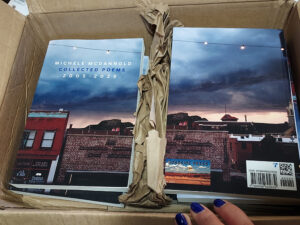
Collected Poems 2005-2025 by Michele McDannold reviewed by Dan Denton

Collected Poems 2005 – 2025 by Michele McDannold: a sort of review
by Dan Denton

About halfway through Michele McDannold’s Collected Poems, I stopped and went back to the beginning. I’d noticed such a wide range of topics and issues confronted by her poetry that I wanted to start over and write them all down. Within the first two dozen poems I was beyond impressed, and it was here that I started to realize that Michele McDannold is the everywoman poet.

Here is a full list of topics I scribbled down while reading to the end: mental health, suicide, talk therapy, abortion, poverty, hunger, food banks, homelessness, domestic violence, child abuse, drug addiction, motherhood, housewives, toxic men, toxic relationships, sex work and sex workers, landlords and slum lords, racism, gender inequality, love, divorce, break ups, cheap motels, unpaid utility bills, work, working at jobs under the poverty line, ex-husbands, harsh holidays, dysfunctional families, lost highways, lost potential, lost hope, roadtrips, and there are poems about small town racism and the big city melting pot.

Collected Poems covers almost every hot-button topic in the news today, and touches upon most every marker of a life lived in poverty. It confronts the atrocities of the powerful and the injustices they thrive upon, and it does all this with no extra words, no fluff, and no bullshit.

McDannold writes with a realism that carves her poems down to the bone with a butcher knife that never goes dull. She doesn’t pull any cute tricks or use fancy words. Her poetry is in your face and it doesn’t care if you’re offended by it. One of the book’s early poems, “Not Recommended,” lets us know that right away:

“this poetry is not recommended
for the high-brow
sissified
punk bitches
who would turn a phrase
just to make you feel stupid”

Throughout the book McDannold writes about the harsh realities of life with an unwavering and honest pen that simplifies the complex. Here, in her poem, “the things we rely on”:

“the past doesn’t matter much
where nobody has a
future”

In her poem “cityscapes while sitting on a cold, cold stone”:

“not everyone has a dream beyond
a warm meal and a safe bed”

and perhaps my favorite, this heartbreaking example, in her poem “while thinking about all those suicidal adults and your own relative story: porch sessions #2: survey”:

“cps.

an acronym meaning
fucked
from the get-go”

These are poems that had to get tough, or die, so it’s only natural that they come from the places where survival is a learned skill, not a birthright. In this poem, “the packinghouse — second shift,” one of my favorites of Michele’s, she writes this, about working in the meat packing industry:

“do not think
of the dead,
but of babies,
men
the rent
heat…”

In this poem about an addicted friend, “not like the movies,” she writes:

“now and again, in a quiet, empty moment
i think about her unwearied commitment
to a slow and lonely death”

While surviving these experiences may have led to poems with a tough exterior, they’ve also brought hard earned lessons. In her poem, “you laugh at rumble bees,” McDannold writes this:

“every experience has its
pearl”

and here, in the poem, “doorbells, mornings and death or (if you are a cunt),” she shares this pearl:

“if you shovel the shit long enough
you might forget what was under there”

in her poem, “before the resurrection,” she shares:

“and I believe that

shutting doors
is better than jumping out of windows”

and in her poem, “west coast notebook entry #6: when you need to sit in a dark theater, crying by yourself, with others,” she offers:

“you notice that our last dollars
were maybe more important than all those other dollars”

Amidst all the hard times, sidewalk grit, rough sides of town, fuck yous, broken glass and plastic flowers, McDannold also takes moments to recall times and places that weren’t all death and danger, as she writes in “the choose your own adventure stories we tell ourselves”:

“all i ever
wanted to write
was a happy ending”

but somewhere along the way she figures out that:

“the “I’m ok —- your ok” is a dead hippie lie”

that comes from one of her most well-known poems, “nothing to lose (or freedom)”.

McDannold doesn’t sugarcoat any of the reality that many of us pretend isn’t there, but one of the things that I love the most about her poetry is the small, undying bits of hope that are sprinkled throughout.
She writes in her poem “something in the way”:

“to be
a lightning bug
smacked to the windshield
glowing bright
for one more
moment”

As I was putting my notes together for this review, I was looking for something to compare Michele McDannold’s work to and I immediately thought of Riot Grrrl, and it fits. Collected Poems is a combat boot-wearing, punk, feminist roar. It’s loud. It’s bold. It’s crass. It ain’t taking no shit, and it’s calling us all to join. McDannold writes near the end of the aforementioned “nothing to lose (or freedom)” :

“get the fuck
out
out of your house
and stick a fist up their ass for doing this”

Collected Poems 2005 – 2025 from Michele McDannold spits in the eyes of The Man and curb stomps the heart of every abuser. It’s a 20 year journal of her hand-to-hand combat with love, and a how-to-guide for keeping your inner spark alive through the worst storms life has to offer.

Collected Poems is out now from Roadside Press. Click this link to order your copy.

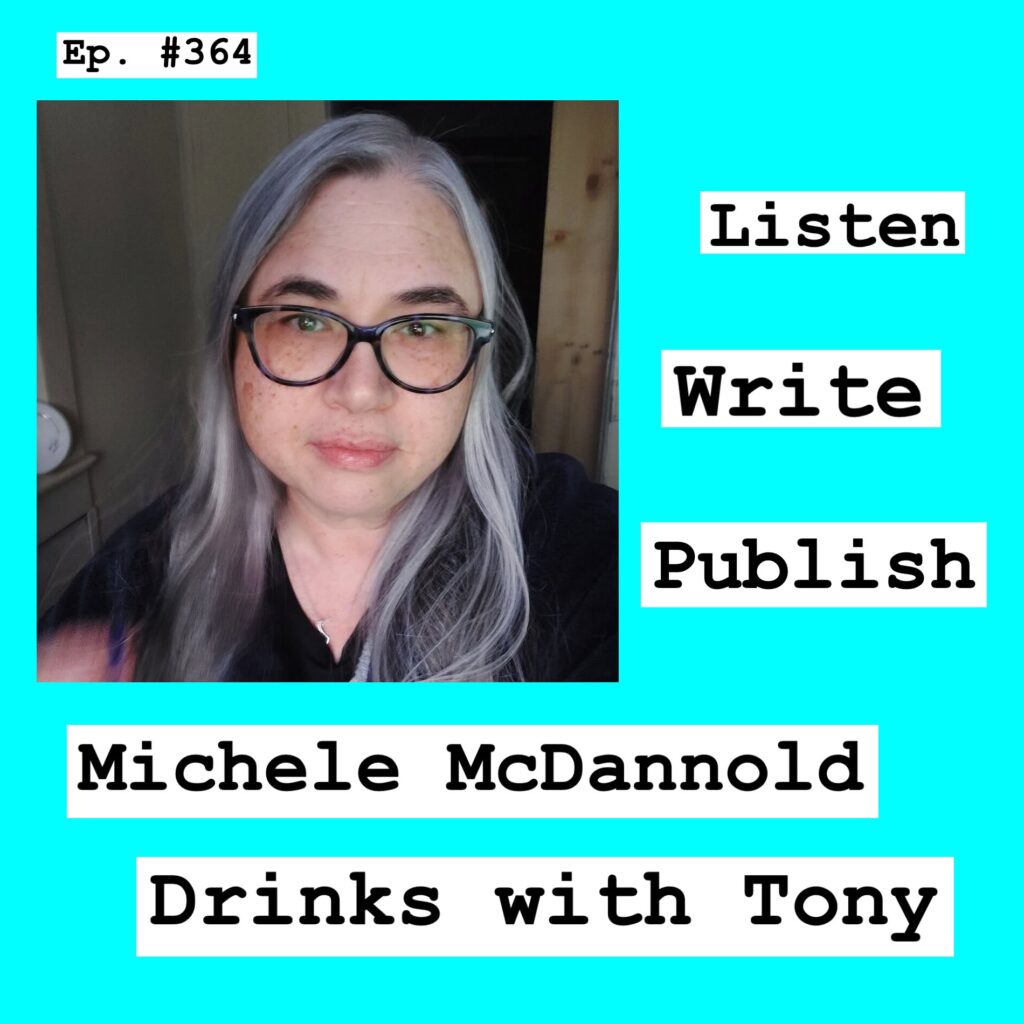
Roadside Press publisher Michele McDannold interviewed at Hobo Camp Review

Check out the latest Hobo Camp Review, marking 16 years in publishing! https://hobocampreview.blogspot.com/2026/01/hobo-camp-review-interview-with-michele.html

Roadside Press’s very own editor/publisher Michele McDannold is interviewed. It begins…

Hobo Camp Review Interview with Michele McDannold

A note from HCR Editor James Duncan: Of the many indie press editors I’ve worked with over the years, Michele McDannold has always stood out for her relentless enthusiasm for the poets she publishes, the unending encouragement and excitement, the effort to get them reviews and blurbs, to get their books and voices and faces on social media, to make a world with more and better and grittier and honest poetry. She’s an absolute tornado of awesome and I’m happy to share this Q&A with you. Seek her work, and she’ll tell you to seek the work of so many other cool poets. Do so!

_______________________________________________________________________


You’ve been involved with the indie small press world for a long while, and in recent years you started publishing poetry, fiction, and essays under Gutter Snob Books and Roadside Press (among others). What inspired you to begin these presses? Zygote in my Coffee/Tainted Coffee Press, Red Fez Publications, Punk Hostage Press… there’s a pretty long list of free-wheeling organizations that inspired me. The DIY Press. The Literary Underground. I’ve always had a healthy love of books. Combine that with all the talent I found in the small press, and I just had to wonder what I might be able to contribute as a publisher. Plus, all these little presses that promised to publish my chapbooks kept shutting down! It seemed like a good thing to obsess over. Little did I know, this would be a lifelong obsession.

READ THE REST OF THE Q&A at https://hobocampreview.blogspot.com/2026/01/hobo-camp-review-interview-with-michele.html